Definition
A vector field is a function which assigns each point in an -dimensional space a corresponding vector of dimensions. Vector fields are commonly depicted, in 2D space for example, as a 2D graph in which every point serves as the starting point for a 2D vector, . In 3D space, , each point is assigned a 3D vector, . A vector field is defined as a function of the coordinates that make up its domain space, for example, a 3D vector field will be a function of , , and , or of , , and . Therefore,
where , , and are orthogonal unit vectors that define a 3D space. An example vector field in 2 dimensions might be,
and would be visualized as,
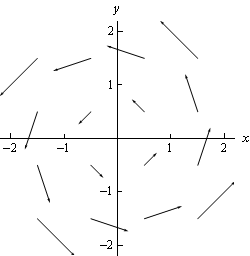
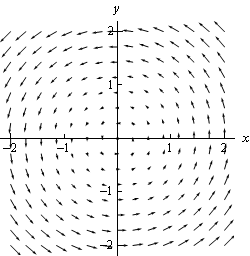 One can see here that at each point , there is a vector equal to . At , we see a vector equal to .
A sample 3D vector field might be,
which is visualized as,
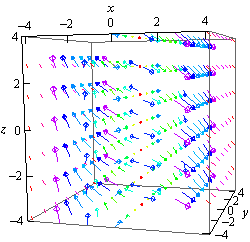
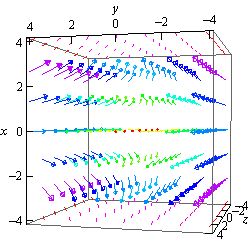
We can see here, too, that at a point there is a vector equal to . For much of calculus and physics, a vector field is required to be (and naturally is) smooth at all points.
The ‘Del’ Operator
We must define a symbolic vector, one which has not real dimensions but which must be a vector for us to use it in vector math, which we will refer to as ‘del’ and which we will denote . This symbolic vector will have components , which may be applied to a scalar function, , or to a vector function, .
We can apply the del operator to the scalar function as follows,
This is called the gradient of , written , and is a vector.
We can apply the del operator to the vector function in two ways, in a dot product or in a cross product, as follows,
which is called the divergence of , written , and is a scalar; or,
which is called the curl of , written , and is a vector.
There is a second way to apply the del operator to a scalar function which is commonly used,
which is called the Laplacian of . Laplace’s differential equation is , and any solution to this which is class is a harmonic function. It should be obvious that this operation is simply taking the divergence of the gradient field of .
Gradient Fields
Divergence
Curl
Curl is a measure of how much a vector field rotates at a given point. We calculate curl as the cross product , which results in another vector field function that represents curl values,
But let us first understand the concept of curl from first principles.
Curl in 1-Dimension
If we have a vector field in one dimension, it has no curl: space consists only of a single line, and every point along the single dimension is assigned a vector represented as , which has magnitude as well as a direction of either forward or backward, or .
Curl in 2-Dimensions
If we have a vector field that exists in two dimensions, then each point is assigned a vector , and any can curl in either a clockwise or counter clockwise direction. That is, compared to the vectors immediately adjacent to it, a vector at a single point can have either a larger or smaller -component (indicating rotation about the y-axis), and/or a larger or smaller -component (indicating rotation about the x-axis).
Differential Derivation
For a vector , is the -component and is the -component. We can conceive of these components as a left-to-right force and an up-and-down force that act on the final vector, and if we sweep a single point through space, it will experience many different lateral or vertical forces according to the function . If we sweep a point along a horizontal line parallel to the x-axis, then an upward vertical force, a positive , will represent a counterclockwise rotation about the centerpoint; a downward force, a negative , will represent a clockwise rotation. Therefore, to discover the curl of along a horizontal line, we must take the derivative of with respect to , .
For the same reason, by sweeping a point along a vertical line and observing the value of at each position, the curl of along a vertical line will be the derivative of with respect to , .
Then, to find the total curl of , we must consider both and . How do we relate them?
Let’s return to basic concepts. At the point , the vector field is . Then at an infinitesimal distance away from that point, at , the vector field is
and at a point ,
Then these changes can be represented as a matrix:
This 2x2 matrix is a Jacobian. Any matrix can be broken apart into a symmetric and antisymmetric component: . Therefore this Jacobian’s antisymmetric component is,
We now have a relationship between and . This matrix represents an infinitesimal rotation, and the off-diagonal element represents the curl of . Thus we have,
Integral Derivation
Suppose the 2D vector field has some closed curve within it, , which itself encloses a 2D space , and that can be parameterized by a function . Then, for every infinitesimal section of , , we can compute the dot product of that small vector with the vector of at that same point, to find the “circulation” of along , which is really just a measure of how much the vector field aligns with a tangent vector to at every point along . Thus we have the integral along a closed curve of dot-producted with an infinitesimal section of :
We can see that, according to this formulation, a longer curve will result in a larger circulation, which is improper: our goal is to measure the circulation of the vector field without considerations of or . For that reason we will also normalize the area to find the circulation per unit area:
where is the area of . This integral can be used to find the curl of at a single point if we shrink the radius (or area, if not a circle) of down to while keeping it centered at , as here:
Instead of conceiving of curl as instantaneous rotation in one direction or the other, we are now thinking of it as the total rotation-per-unit-area of an infinitesimally small area. Greene’s Theorem states,
Here we can see that this former expression of curl is identical to the differential form.
The Laplacian
Example
Let . Then,
Therefore is harmonic.