Definition
For a function which is defined on the interval , then the integral of that function is
Derivation
The integral originally solved the problem of finding the areas of certain geometric shapes or curves; introductory explanations of the integral still approach by this route.
The Line Integral
The line integral is an extension of the regular Riemann integral which is applied to a curve in vector space. It can be denoted symbolically with the usual integral symbol, or with the special “path integral” symbol which indicates that the curve is closed:
Scalar Valued Functions
Suppose there is a curve that exists in -dimensional space , in the presence of a scalar field . Suppose that is expressed by a parameterized function which completely describes , so that, if is defined on the interval , and represent the endpoints of (in notation, ). If the vector field exists everywhere in some subset of the -dimensional space, which we’ll call , and if the curve is confined within (in math notation, ), which is to say that is everywhere affected by , then we can define the line integral of along to be the dot product of at some point with the tangent line of . In notation,
One should note that the derivative of is equal to its tangent line, that must also be regular, i.e. the tangent vector is never zero, and that must be piecewise smooth.
Wikipedia provides a useful visualization of this: ![][https://upload.wikimedia.org/wikipedia/commons/4/42/Line_integral_of_scalar_field.gif]

Vector Valued Functions
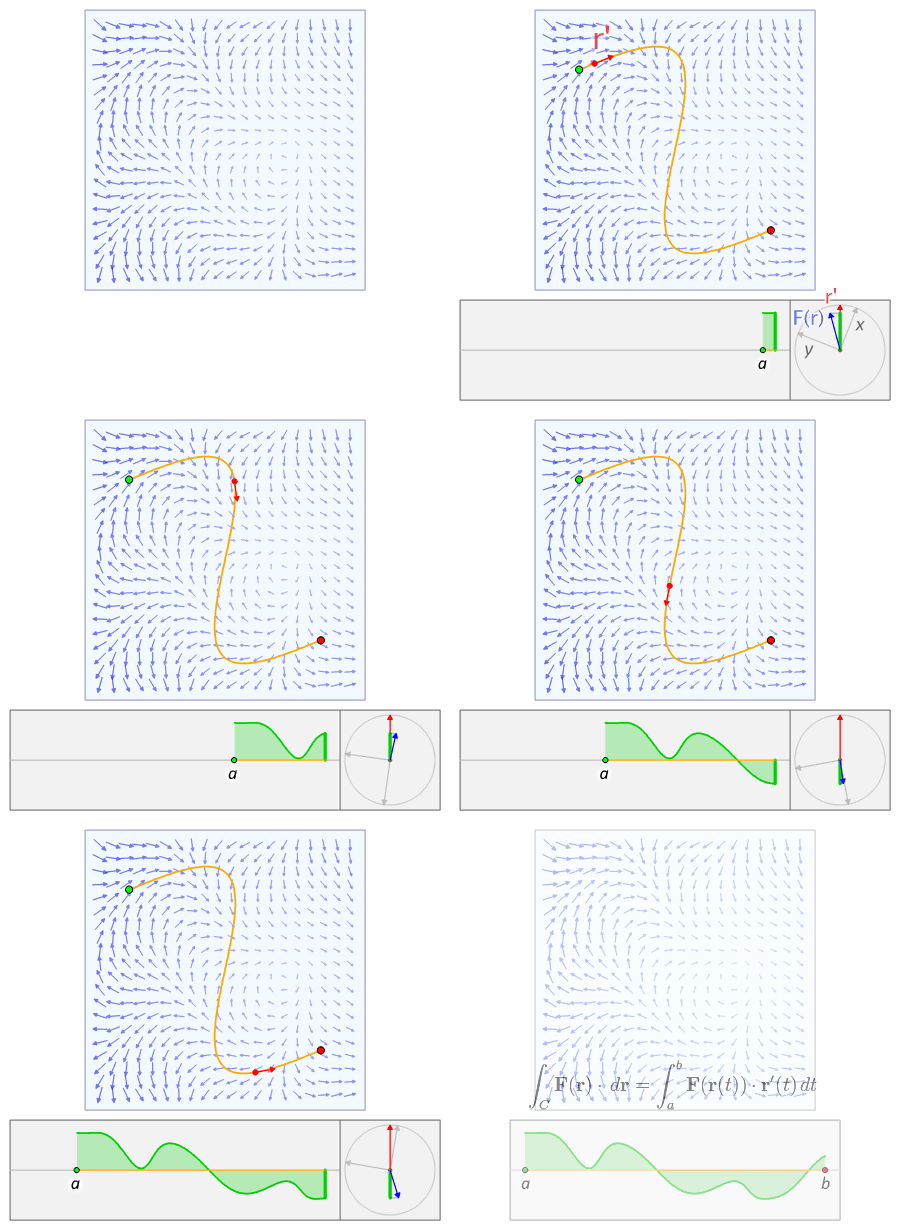
Suppose there is a curve that exists in -dimensional space , in the presence of a vector field . Suppose that is expressed by a parameterized function which completely describes , so that, if is defined on the interval , and represent the endpoints of (in notation, ). If the vector field exists everywhere in some subset of the -dimensional space, which we’ll call , and if the curve is confined within (in math notation, ), which is to say that is everywhere affected by , then we can define the line integral of along to be the dot product of at some point with the tangent line of . In notation,
One should note that the derivative of is equal to its tangent line, that must also be regular, i.e. the tangent vector is never zero, and that must be piecewise smooth.
Wikipedia provides a useful visualization of this: ![][https://upload.wikimedia.org/wikipedia/commons/b/b0/Line_integral_of_vector_field.gif]
The Surface Integral
The surface integral is an extension of the double integral to integrate over a surface in three-dimensional space. The surface, typically called , must be in the presence of a scalar field or a vector field; if a scalar field, then the surface integral calculates the field’s weighted values within , if a vector field, then the integral calculates the amount of flux passing through , where flux is a sum of the vector field over the area of S.
Suppose there is a surface which resides in 3D space, .
Over Scalar Fields
Suppose resides in the presence of a scalar field . We can label the region of which is affected by as , so and . Then we can conceptually define a surface integral as the double integral of over all points of :
where is an infinitesimal area element on . is usually defined for a 3D space by a parameterized vector-valued function . In this case, we can rewrite the above abstract integral in terms of this parameterization ,
We can see this formula represents the value of at some point defined by , multiplied by the magnitude of the cross product of the derivative of with respect to , and the derivative of with respect to . Geometrically this represents the magnitude of a normal vector at any point on multiplied by the value of the scalar field at that same point.
Note that if , then the surface integral of will equal the surface area of .
Over Vector Fields
Suppose resides in the presence of a vector field with -dimensions. We can label the region of which is affected by as , so and . Then we can conceptually define a surface integral as the double integral of over all points of :
where is an infinitesimal area element on , and is a unit normal vector to for any orientation. is usually defined for a 3D space by a parameterized vector-valued function . In this case, we can rewrite the above abstract integral in terms of this parameterization ,
We can see that we first form a normal vector by crossing the two derivatives of with respect to and to , then dot product this normal vector with the value of the vector field at the same point.
The quantity calculated from this surface integral is referred to as flux, which quantifies the amount of vector field lines passing through .